
Australia’s Rapid Growth in BESS Deployment
For developers, operators and project teams, the practical message is clear: BESS fire safety is not just about preventing thermal runaway. It also requires planning for what happens if a failure occurs, including gas release, explosion potential, emergency access, water supply, plume impacts and long-duration incident management.
Australia’s electricity sector is undergoing a significant transformation as battery energy storage systems (BESS) are deployed to support the transition away from fossil fuels. BESS are large-scale batteries connected to the power grid that can provide frequency control, load shifting, network support and energy firming services. The International Energy Agency (IEA) describes battery storage as one of the fastest-growing energy technologies globally, with strong momentum in Australia.
The IEA has reported rapid growth in Australia’s battery storage market, with battery capacity additions reaching nearly 8 GW in 2025, almost nine times higher than the previous year. Separate industry reporting indicates that Australia commissioned approximately 4.9 GWh of grid-scale BESS capacity in 2025, highlighting the rapid acceleration of the sector and the increasing reliance on battery storage as a key element of future energy infrastructure.
This rapid growth creates a simple risk-management challenge: the more BESS becomes part of essential energy infrastructure, the more important it becomes to understand the full range of credible fire, explosion and emergency response scenarios.
As a result, battery safety is attracting greater scrutiny. Thermal runaway is the most widely discussed lithium-ion battery failure mechanism, but focusing on it alone oversimplifies the broader fire safety challenge. BESS projects also require careful consideration of design, operation, emergency response, gas management, explosion risk and post-incident recovery.
What Thermal Runaway Actually Is
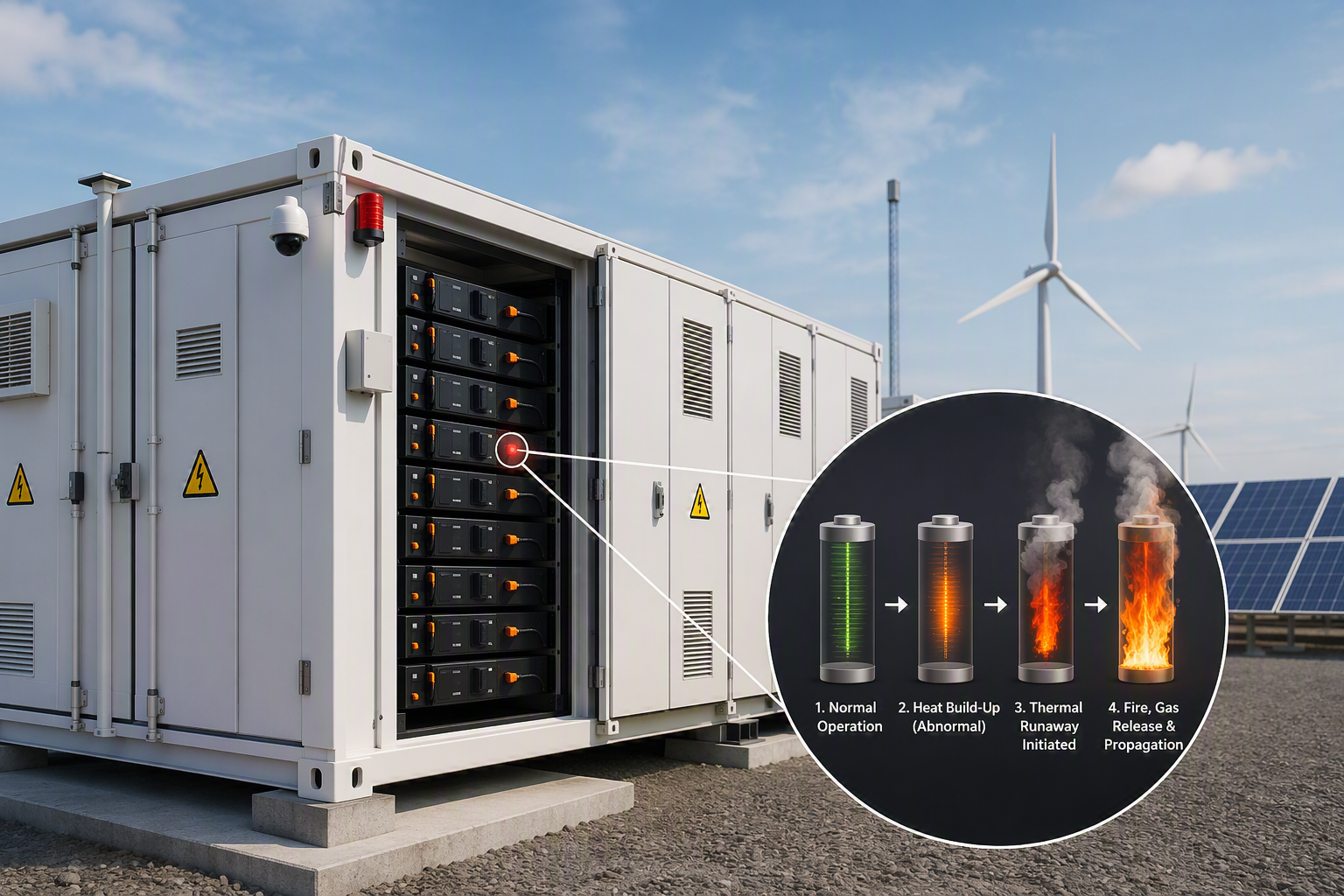
Thermal runaway is the process by which a battery cell experiences an uncontrollable increase in temperature due to internal chemical reactions that generate heat faster than it can be dissipated. Once initiated, the cell may vent hot gases, ignite or rupture, potentially exposing adjacent cells to thermal and mechanical stresses that can trigger further failures. Thermal runaway can be initiated by a variety of causes, including manufacturing defects, electrical faults, overcharging, physical damage, cooling system failures and external fire exposure.
Importantly, thermal runaway should not be confused with the fire itself. Rather, it is an initiating failure mechanism that may subsequently lead to fire, gas release, explosion hazards or propagation through a battery unit. This distinction is critical because many risk assessments and public discussions focus on preventing the initiating event without adequately addressing the consequences that may occur once it has already begun. Industry testing standards such as UL 9540A and installation standards such as NFPA 855 provide useful frameworks for evaluating propagation, gas generation, explosion control and fire protection effectiveness during abnormal events.
Why a Battery Fire Is Different from a Conventional Fire
Traditional fires are typically driven by external fuels that burn in the presence of atmospheric oxygen. Battery fires, by contrast, can involve lithium-ion cell failures and complex electrochemical reactions within the cells themselves. Even when visible flames are controlled, damaged cells may continue generating heat internally, creating the potential for delayed reignition or ongoing propagation.
The challenge is further compounded by the fact that battery systems contain substantial amounts of stored energy and are often housed within compact, highly engineered enclosures. The result is a hazard that behaves differently from typical industrial fire scenarios. Fire suppression may not immediately halt the underlying failure processes, and incident management can extend for many hours or even days. Consequently, emergency response strategies often prioritise cooling, monitoring, exposure protection and hazard isolation alongside traditional firefighting tactics.
Toxic Gases, Explosion and Plume Hazards
One of the most significant yet frequently overlooked aspects of BESS fire safety is the generation of hazardous gases. During thermal runaway, battery cells may release a mixture of flammable, toxic and corrosive gases, including hydrogen, carbon monoxide, hydrogen fluoride and volatile organic compounds. Depending on the battery chemistry and operating conditions, these gases can accumulate rapidly within enclosed spaces and create hazardous atmospheres long before any visible fire develops.
The accumulation of flammable gases introduces the potential for deflagration or explosion events if an ignition source becomes available. Several high-profile international BESS incidents have demonstrated that gas accumulation and delayed ignition can cause substantial damage even where the initial battery failure appears limited. Examples commonly cited in industry discussions include the Arizona McMicken BESS explosion, the Vistra Moss Landing BESS fire in California and the Drogenbos BESS incident in Belgium. These events have contributed to increased industry focus on gas detection, mechanical ventilation, explosion management measures and enclosure design.
In addition to immediate life safety concerns, battery fires can produce smoke plumes containing combustion products, particulates and trace metal compounds. These emissions can have implications for first responders, nearby communities and environmental receptors. Accordingly, plume dispersion and contamination considerations have become increasingly important components of modern Fire Safety Studies and emergency response planning.
What Emergency Services Need to Know
From an emergency response perspective, BESS facilities present a distinctly different risk profile to conventional industrial facilities. Responders must contend with electrical hazards, toxic atmospheres, potential explosion risks and prolonged incident durations. Traditional firefighting assumptions may not always apply, particularly where thermal runaway propagation is occurring within sealed battery enclosures.
For this reason, early engagement between project developers and emergency services has become increasingly important. Emergency responders require clear information on battery chemistry, site layout, access arrangements, water supplies, fire protection systems, isolation procedures and emergency shutdown capabilities. Pre-incident planning enables responders to develop site-specific tactics and make operational decisions based on verified information rather than assumptions during an emergency. Effective emergency preparedness is therefore not simply a regulatory requirement but a critical component of overall risk management.
The Importance of Fire Safety Studies, Preliminary Hazard Analyses and Fire Risk Assessments
As BESS projects continue to grow in scale, the importance of structured risk assessment processes has increased substantially. A Preliminary Hazard Analysis (PHA) is a proactive, early-stage risk assessment used to identify potential hazards, estimate accident consequences and define safety measures. This allows designers to identify potential risks before they become embedded within the project. Fire Risk Assessments (FRA) provide a more focused evaluation of fire-related scenarios, protection measures and residual risks.
A Fire Safety Study (FSS) is a systematic risk management assessment used to evaluate fire, explosion and toxic release hazards at a site, with a focus on the magnitude, severity and mitigation of potential on-site and off-site impacts. For BESS projects, an FSS can help demonstrate that credible fire and explosion scenarios have been identified, assessed and managed through appropriate design, operational and emergency response controls.
These studies serve as essential decision-making tools rather than merely approval documents. They help establish whether fire protection systems, separation distances, emergency response arrangements and operational controls are appropriate for the specific technology being deployed. They also provide a structured framework for demonstrating to regulators, emergency services, insurers and project stakeholders that foreseeable risks have been systematically identified and managed. International guidance such as NFPA 855 places strong emphasis on technology-specific hazard analyses and mitigation measures that address thermal runaway propagation, gas generation, explosion hazards and fire protection effectiveness.
Why Early Fire Engineering Involvement Matters
Early involvement of fire engineers allows potential issues to be identified while solutions remain practical and cost-effective. Fire engineering input can help integrate lessons from UL 9540A testing, hazard studies, regulatory expectations and emergency service requirements into a cohesive safety strategy. This proactive approach can support more robust designs, smoother approval pathways and reduced operational risk. From both a technical and commercial perspective, fire safety is most effective when it is designed into a project rather than added later as a compliance exercise.
Early involvement of fire engineers allows potential issues to be identified while solutions remain practical and cost-effective. Fire engineering input can help integrate lessons from UL 9540A testing, hazard studies, regulatory expectations and emergency service requirements into a cohesive safety strategy. This proactive approach can support more robust designs, smoother approval pathways and reduced operational risk. From both a technical and commercial perspective, fire safety is most effective when it is designed into a project rather than added later as a compliance exercise.
Key Lessons for Developers and Operators
The rapid expansion of Australia's battery storage industry has highlighted the need for a broader understanding of BESS fire safety. While thermal runaway remains an important initiating event, the true challenge lies in managing its potential consequences, including fire propagation, toxic gas generation, explosion hazards, environmental impacts and complex emergency response requirements.
Developers and operators who adopt a holistic risk management approach are better positioned to deliver safe, resilient and socially accepted projects. This requires more than compliance with minimum requirements. It requires a clear understanding of how battery systems behave under fault conditions, early engagement with fire engineering specialists and emergency services, and rigorous hazard assessment throughout the project lifecycle. As BESS deployment continues to accelerate across Australia, the strongest projects will be those that move beyond thermal runaway and address the full spectrum of fire safety challenges posed by modern battery energy storage systems.
References
- Aiello, I. W. (2025, December 1). When the world’s largest battery power plant caught fire, toxic metals rained down – wetlands captured the fallout. The Conversation. https://doi.org/10.64628/AAI.kc4jxrgnx
- Battery storage is scaling up and taking on a larger system role – Analysis. (2026, May 29). IEA. https://www.iea.org/commentaries/battery-storage-is-scaling-up-and-taking-on-a-larger-system-role
- Bugryniec, P. J., Resendiz, E. G., Nwophoke, S. M., Khanna, S., James, C., & Brown, S. F. (2024). Review of gas emissions from lithium-ion battery thermal runaway failure—Considering toxic and flammable compounds. Journal of Energy Storage, 87, 111288. https://doi.org/10.1016/j.est.2024.111288
- Fire in a battery energy storage system. (2022, November 18). CFPA Europe. https://cfpa-e.eu/fire-in-a-battery-energy-storage-system/
- National Fire Protection Association. (2026). NFPA 855: Standard for the Installation of Stationary Energy Storage Systems. NFPA.
- Technology: Battery storage – Global Energy Review 2026 – Analysis. (n.d.). IEA. Retrieved July 15, 2026, from https://www.iea.org/reports/global-energy-review-2026/technology-battery-storage
- The Arizona McMicken BESS Explosion: Key Takeaways - EticaAG. (2025, April 17). https://eticaag.com/the-arizona-mcmicken-bess-explosion-key-takeaways/
- Understanding UL 9540A, NFPA 855 and Large-Scale Fire Testing for Battery Energy Storage Systems. (n.d.). UL Solutions. Retrieved July 15, 2026, from https://www.ul.com/thecodeauthority/knowledge/understanding-UL-9540A-NFPA-855
- US EPA. (2025, August 21). Battery Energy Storage Systems: Main Considerations for Safe Installation and Incident Response. https://www.epa.gov/electronics-batteries-management/battery-energy-storage-systems-main-considerations-safe