
A New Era of Fire Risk
For renewable energy projects, fire-water demand is no longer just a compliance calculation. It is a practical design question that affects emergency response, environmental containment, site resilience and community confidence.
Australia’s energy sector is changing rapidly. Across the country, traditional generation is increasingly being supplemented, and in some places replaced, by renewable infrastructure at a scale we have not seen before. Solar farms, battery energy storage systems and other renewable technologies are becoming permanent features of the built environment and critical parts of the national energy network. This shift creates new design challenges for fire engineers, particularly in how fire events are managed on site and what those events mean for fire-water demand.
The practical implication is that fire-water planning for renewable energy sites needs to be considered early in design, not treated as a late-stage services coordination issue.
Why Renewable Energy Fires Are Different
These facilities do not behave like traditional building fires. Long-standing assumptions about how much water is needed, how quickly a fire can be controlled and what suppression will look like in practice are being tested by renewable energy assets. In many cases, the question is not simply whether enough water is available to extinguish a fire. It is whether sufficient water is available to support a prolonged defensive response, protect adjacent equipment and manage contaminated runoff over an extended period.
Two technologies help illustrate the issue clearly: photovoltaic systems and battery energy storage systems (BESS). Solar panels can continue generating electricity whenever sufficient sunlight is present, which means parts of the system may remain an electrical hazard even after downstream isolation. For emergency responders, that creates an obvious challenge. Firefighters cannot always approach and intervene in the same way they would at a conventional building fire, because live electrical components may still be present.
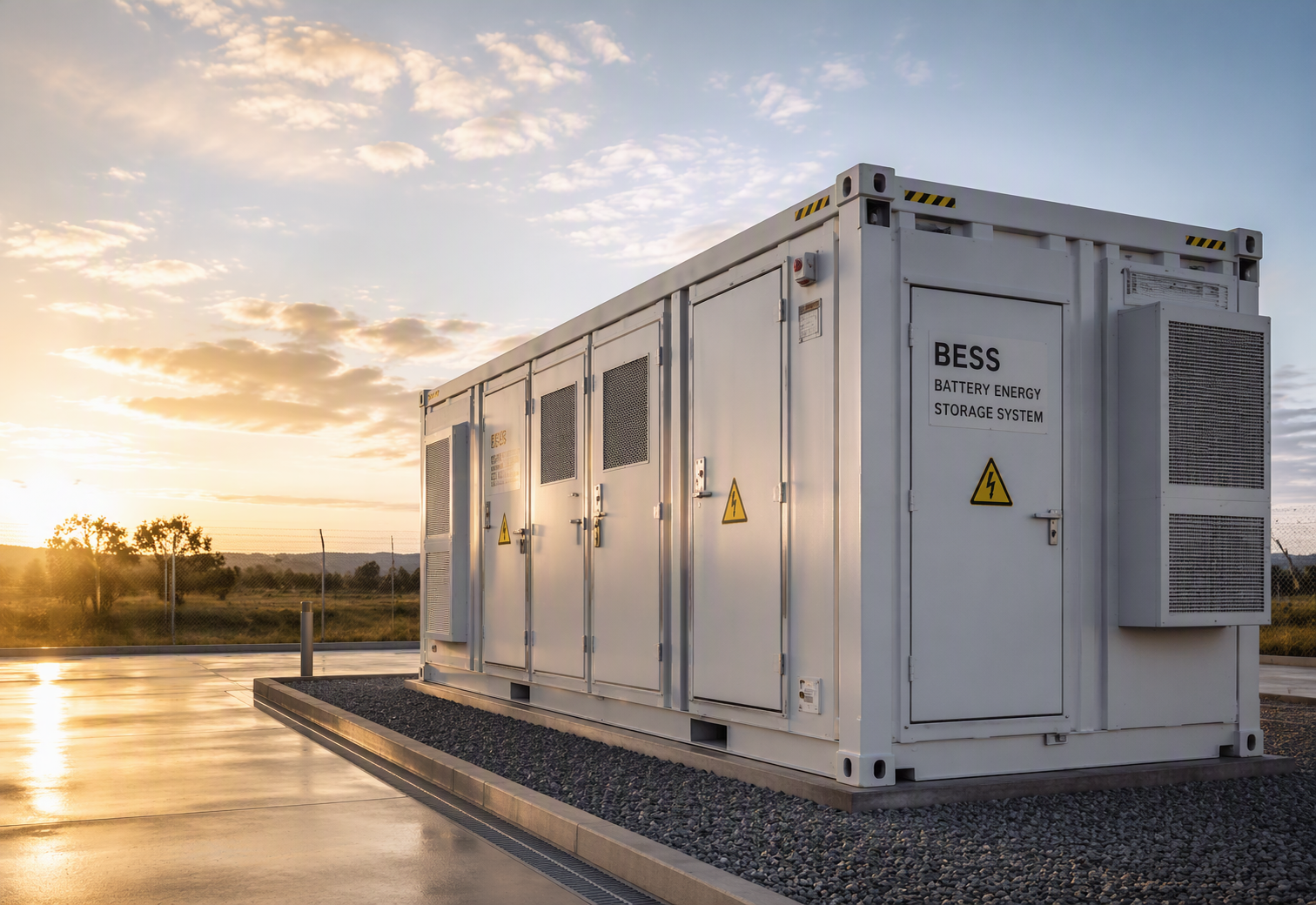
Battery systems introduce a different but equally significant hazard. A BESS unit can contain thousands of cells arranged within modules and racks inside a containerised enclosure. When one or more cells fail, whether through overheating, physical damage or electrical abuse, this can result in thermal runaway. Thermal runaway is a self-sustaining exothermic process that generates heat and can drive failure into adjacent cells. Rather than presenting as a single fire event with a predictable growth and decay phase, battery fires can escalate in stages, subside and then re-escalate as further cells become involved. That behaviour fundamentally changes both fire development and fire-fighting strategy.
From Extinguishment to Defensive Response
In a conventional building fire, water is commonly used offensively as an extinguishing agent. Fire brigades can often apply water directly to the seat of the fire, cool the fuel and interrupt combustion. In renewable energy incidents, that approach may be unsafe or ineffective. Electrical isolation may be required before responders can safely access equipment and, in battery containers, many cells may be buried deep within the unit where externally applied water has limited impact. As a result, the strategy often shifts from direct extinguishment to defensive cooling of nearby assets while the affected unit is isolated, contained and allowed to burn out under controlled conditions.
An example of this is the Chaumont Solar Farm and Battery Storage Facility in New York State, which caught fire in 2023. A fault in a battery cell led to rapid heating, thermal runaway and fire involvement of an entire BESS container. When firefighters arrived, access was delayed while the site was isolated, a process that took eight hours. Once entry was gained, the response focused on cooling adjacent units rather than directly extinguishing the container that was already burning. The incident ultimately involved eight days of firefighting operations and used approximately 1.9 million litres of water.
Designing for Long-Duration Fire Events
In the Australian context, this creates an important design challenge because the National Construction Code (NCC) does not contain prescriptive requirements written specifically for large-scale BESS or similar renewable energy hazards. These facilities may therefore require project-specific fire engineering assessment, rather than relying only on a standard deemed-to-satisfy pathway. In practice, the final fire-water demand for a site is influenced by several inputs, including baseline hydrant provisions, the outcomes of the fire engineering assessment, the expectations of referral authorities such as fire brigades and, in some cases, additional requirements imposed by site operators.
The Fire Safety Study (FSS) can play a central role in that process. An FSS assesses credible fire scenarios, the adequacy of fire safety systems, suppression and detection measures, smoke management, explosion hazards and fire-water runoff. It can also look beyond Australian Standards alone, drawing on broader guidance including NSW HIPAP 2, state-based renewable energy guidance and contaminated water management documents. In Victoria, BESS is recognised in Fire Rescue Victoria guidance as a facility type that may require an FSS, with the framework acknowledging that battery fire risk is shaped not only by the quantity of stored energy, but also by behaviour, escalation potential and operational response.
From a fire-water perspective, two inputs are particularly important. The first is AS 2419.1, Fire hydrant installations, especially its open yard provisions, which establish baseline fire-water requirements for external equipment areas and generally apply at the site scale. The second is the Fire Safety Study, which assesses whether the baseline water demand is sufficient for the hazards present. If credible fire scenarios indicate that long-duration cooling, multiple appliances or extended exposure protection are likely to be required, additional water capacity may need to be provided beyond the standard minimum.
Because renewable energy fire events can involve long-duration water application, they can also generate large volumes of contaminated runoff containing battery electrolytes, heavy metals and combustion products. For that reason, site design also needs to account for containment. Retention ponds, tanks, bunded areas and stormwater isolation systems are increasingly forming part of renewable energy developments so that fire-water can be captured and held on site. Importantly, these systems are generally sized around worst-case fire demand, recognising that prolonged incidents can produce far greater runoff volumes than a short-duration suppression event in a conventional building.
Rethinking Fire-water Demand
As Australia continues its energy transition, these issues will become more relevant. Renewable infrastructure is reshaping the fire risks we design for and changing what adequate fire protection needs to address. For fire engineers, the challenge is no longer just compliance with a standard. It is designing sites that are operationally workable during a real incident, support emergency response and responsibly manage the consequences of prolonged fire-fighting operations. That is where the real conversation on fire-water demand now sits.